Visiting Xi ‘an Satellite TT&C Center: Satellite Housekeeper Casting a Monument
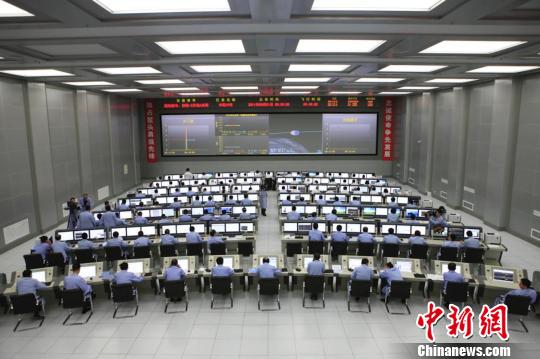
Xi ‘an Satellite TT&C Center is the earliest, largest and most functional spacecraft TT&C and management center in China, and has successfully completed hundreds of TT&C tasks for space launch. Photo by Zhang Chengwei
Zhongxin. com, Xi ‘an, April 25th: The satellite "housekeeper" casts a "monument" — — Visit China Xi ‘an Satellite TT&C Center
Author Zhang Chengwei Zhang Su
The ancient city of Xi ‘an is an international city where human history and modern science and technology complement each other. Xi ‘an Satellite TT&C Center, located here, is the earliest, largest and most functional spacecraft TT&C and management center in China, and has successfully completed hundreds of TT&C tasks for space launch.
The reporter learned that on June 23rd, 1967, China established the Satellite Ground Survey Department, which was the predecessor of Xi ‘an Satellite TT&C Center. In September 1975, the center was formally established.
The relevant person in charge said that the temporary command and control center that initially performed a single measurement and control task has developed into a modern space measurement and control center that integrates real-time measurement and control of spacecraft and long-term management of spacecraft in orbit. There is the only land-based space TT&C network in China, with TT&C sites spread all over five continents and 13 provinces and regions in China.
The first monument
China has no ready-made experience to learn from in building sophisticated satellite ground observation systems. The technicians of the satellite ground survey department started from scratch, worked hard, built the computer room, installed the antenna and laid the cable by themselves, debugged the equipment in the heat and cold, and wrote the program under the oil lamp in the humble room, which passed the difficult years in the history of measurement and control.
Under the auspices of Academician Chen Fangyun, the scientific and technical personnel gathered their wisdom to tackle key problems and worked out the measurement technical scheme of China’s first artificial satellite.
On April 24th, 1970, the "Dongfanghong-1" satellite flew to Tianyu, and China became the fifth country in the world to launch a domestic satellite with a homemade rocket after the Soviet Union, the United States, France and Japan. The launch measurement and control of the "Dongfanghong-1" satellite was a complete success. The center accurately predicted the time and position of the satellite flying over 244 cities in the world, and set up Chinese’s first "milestone" in the vast sky.
People follow the stars.
In the years after the successful launch of Dongfanghong-1 satellite, the United States and the Soviet Union launched several recoverable satellites. At that time, China had "two bombs and one satellite", its national strength gradually increased, and China astronauts were full of confidence.
On November 26th, 1975, China successfully launched its first recoverable satellite. The central activity monitoring and recovery unit "people move with the stars", using radio direction finder and other equipment to capture satellites returning at high speed independently, creating a successful achievement in satellite recovery.
Synchronous fixed point
In 1970s, the space powers accelerated the pace of space race. China executives pointed out: "China is a developing country. It will not participate in the space race in terms of space technology, and it should concentrate on urgently using practical satellites." China’s first applied satellite "Dongfanghong II" communication satellite came into being.
On April 8, 1984, China successfully launched the first communication satellite "Dongfanghong II". The center and the monitoring stations fought continuously, carefully monitored and controlled for 8 days and nights, and successfully positioned the satellite over the equator at 125 degrees east longitude and 36,000 kilometers. China became the fifth country in the world to launch a geostationary orbit satellite.
Spacecraft recovery
On September 21, 1992, China’s manned spaceflight project was launched. The center undertakes two major system tasks: measurement and control communication and landing site.
The landing site system is mainly responsible for the search and recovery of spacecraft return capsule and the search and rescue of astronauts. It is a complex system engineering with air-ground integration and multi-disciplinary cooperation. As the leading unit of the landing site system, the Center organized and coordinated more than 10 departments and units, including Aerospace Science and Technology Corporation, and set up an all-weather manned space search and rescue force with high mobility, forming a set of scientific program flow of recovery and measurement of the return capsule, high-precision impact prediction and astronaut search and rescue, and establishing a fast and safe search and rescue mode of "searching and rescue astronauts in the air and disposing the return capsule on the ground".
During the TT&C recovery mission of the Shenzhou-1 to Shenzhou-10 spacecraft, the center organized a search for rescue forces and repeated drills, creating a world space miracle that "rescuers arrived at the astronaut landing site in 30 seconds", the difference between the predicted landing point and the actual landing point was only 280 meters, and the orbital accuracy reached meters.
Multi-star management
In 1990s, in order to meet the needs of multi-satellite launching and parallel management, the Center put forward the optimal allocation strategy and algorithm of TT&C resources, and initially realized the separation of TT&C network management and spacecraft management. Since the beginning of this century, the number of spacecraft in orbit has increased, and the center has independently developed several sets of precision orbit control software, such as multi-satellite co-location control, constellation configuration control and multi-satellite formation flight. The accuracy of orbit calculation and control has always been at the leading domestic and international advanced levels.
In recent years, the center has vigorously promoted the automation construction of measurement and control system, and the space measurement and control network has gradually realized the automatic operation of "manned and unattended", which has a high level of visualization, informationization, automation and intelligence.
At present, there are more than 100 spacecraft in orbit managed by the center, and it has the ability to carry out orbit determination, state monitoring, attitude adjustment, orbit control and maintenance for 200 spacecraft in orbit at the same time. These in-orbit spacecraft have played an important role in information security in major events such as the Beijing Olympic Games and earthquake relief.
Deep space exploration
Driven by major aerospace projects such as lunar exploration, the center has overcome a series of key technologies such as long-distance tracking and measurement, and its measurement and control capability has achieved a major leap from earth orbit to lunar and deep space orbit spacecraft tracking and control.
During Chang ‘e-1’ s flight around the moon, the center made the communication distance of TT&C as far as 400,000 kilometers for the first time, knocking on the door of TT&C in deep space. In the "Chang ‘e II" mission, the center completed the whole tracking and measurement and control task from flying to circling the moon until the end of its life, and extended the distance record of measurement and control communication to 80 million kilometers.
In 2013, the center organized a tracking measurement test on the ESA Venus Express, and the measurement and control communication distance successfully exceeded 250 million kilometers. In the "Chang ‘e III" mission, the center adopted a series of advanced deep space measurement methods to ensure the accurate landing of the probe on the moon, and successfully carried out major space technology experiments such as lunar surface exploration, laying the foundation for the subsequent exploration of extremely distant stars such as Mars.
Looking back, the years are like songs; Looking to the future, the mission urges the levy. A new generation of space TT&C personnel will keep up with the forefront of world space science and technology development, blaze new trails and forge ahead hand in hand. (End)