Domestic colleges and universities expose plagiarism again.
Recently, The Paper (www.thepaper.cn) received a report that a master’s degree thesis of Northeastern University was similar to a master’s degree thesis of Shanghai Jiaotong University in a large area.
These two papers are respectively the master’s thesis of Sun Yong, a graduate of Northeastern University majoring in mechanical engineering in 2008, "Optimal Design and Simulation Analysis of the Pneumatic System of Vacuum Cleaner" (hereinafter referred to as "Sun Yong’s thesis") and the master’s thesis of Li Bihong, a graduate of Shanghai Jiaotong University majoring in vehicle engineering in 2006, "Structural Design and Optimization of the Pneumatic System of Vacuum Cleaner" (hereinafter referred to as "Li Bihong’s thesis").
Cover of Sun Yong’s paper
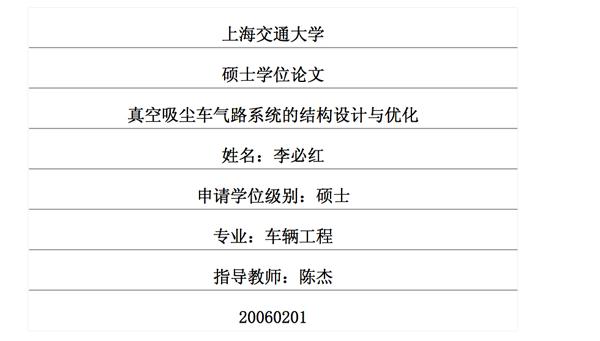
Cover of Li Bihong’s paper
Li Bihong’s thesis was completed in February 2006, and Sun Yong’s thesis was completed in January 2008. In terms of time, Sun Yong’s thesis was completed nearly two years later than Li Bihong’s.
The Paper reporter downloaded the above two papers from Wanfang Data Knowledge Service Platform. After comparison, it is found that the main contents of the two papers are highly similar, and several paragraphs are almost verbatim, and nearly 80% of the references are completely consistent.
On the afternoon of April 2, The Paper contacted the Academic Committee of Northeastern University and the Scientific Research Office of the School of Mechanical Engineering and Automation of Northeastern University. The staff of both institutions said that they were not aware of the matter and could not give a specific reply for the time being.
Later, The Paper contacted Yang Ying, the instructor of Sun Yong’s thesis and a professor at the School of Mechanical Engineering and Automation of Northeastern University. "Just follow the normal (reporting) channels." Yang Ying said to The Paper.
The content of the text is highly similar
After comparing the two papers, The Paper found that the research objects of the two papers are the gas path system of the vacuum cleaner.
The structure of Li Bihong’s paper is divided into five chapters, namely "Introduction", "Brief introduction of the air path system of the vacuum cleaner", "Structural design and optimization of the suction port of the vacuum cleaner", "Structural design and improvement of the gravity settling chamber of the vacuum cleaner" and "Summary and discussion".
Compared with the structure of Li Bihong’s paper, Sun Yong’s paper has two more chapters, which are divided into seven chapters, namely, introduction, brief introduction of vacuum cleaner and its working principle, analysis of working medium characteristics of gas pump, dust particle movement mechanism and design of suction port, simulation analysis and structure optimization of suction port, simulation analysis and optimization design of gravity settling chamber and summary and discussion.
Although the structural design of the two papers is different, part of the text is highly similar.
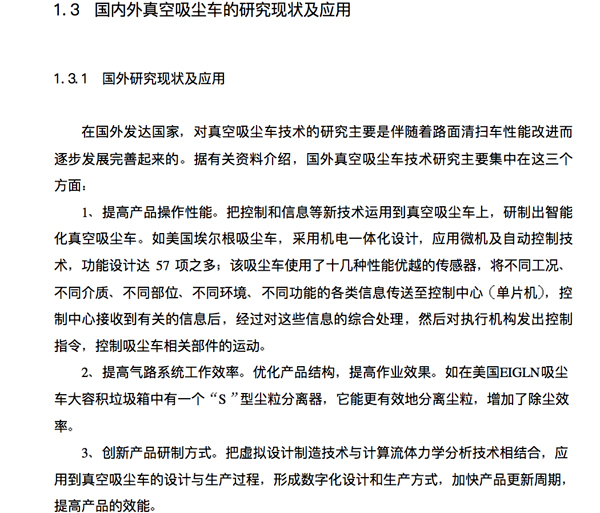
The third section of the first chapter of Li Bihong’s thesis.
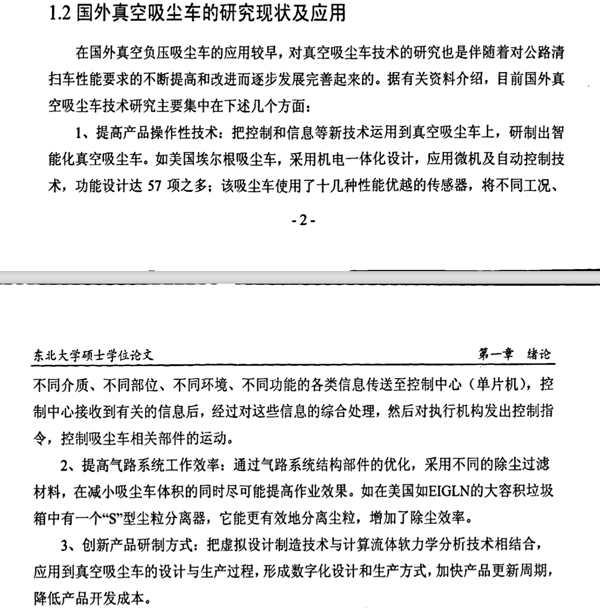
The second section of the chapter "Introduction" of Sun Yong’s thesis.
Taking the first chapter "Introduction" as an example, Li Bihong’s paper wrote in the first paragraph of the third section of this chapter "Research Status and Application of Vacuum Cleaning Vehicles at Home and Abroad": "In developed countries abroad, the research on vacuum cleaning vehicle technology is gradually developed and perfected with the improvement of road sweeper performance. According to the relevant information, the technical research of vacuum cleaner abroad mainly focuses on these three aspects: 1. Providing the operating performance of products. New technologies such as control and information are applied to the vacuum cleaner, and an intelligent vacuum cleaner is developed. For example, the vacuum cleaner in Elgen, USA, adopts electromechanical integration design, applies microcomputer and automatic control technology, and has 57 functional designs; The vacuum cleaner uses more than a dozen sensors with superior performance, and transmits all kinds of information with different working conditions, different media, different parts, different environments and different functions to the control center (single chip microcomputer). After receiving the relevant information, the control center comprehensively processes the information, and then sends control instructions to the actuator to control the movement of relevant parts of the vacuum cleaner. 2. Improve the working efficiency of the gas path system. Optimize the product structure and improve the operation effect. For example, there is an’ S’ type dust particle separator in the large-volume garbage bin of EIGLN dust collector in the United States, which can separate dust particles more effectively and increase the dust removal efficiency. 3. Innovative product development methods. Combining virtual design and manufacturing technology with computational fluid dynamics analysis technology, it is applied to the design and production process of vacuum cleaner, forming digital design and production mode, speeding up product renewal cycle and improving product efficiency. "
The second section of the "Introduction" chapter of Sun Yong’s paper is "Research Status and Application of Vacuum Cleaners Abroad". In the first paragraph, the specific expression is: "The application of vacuum vacuum cleaner was earlier in foreign countries, and the research on vacuum cleaner technology was gradually developed and perfected with the continuous improvement of the performance requirements of public sweepers. According to relevant information, the research on vacuum cleaner technology abroad is mainly focused on the following aspects: 1. Providing product operability technology: applying new technologies such as control and information to vacuum cleaner, and developing intelligent vacuum cleaner. For example, the vacuum cleaner in Elgen, USA, adopts electromechanical integration design, applies microcomputer and automatic control technology, and has 57 functional designs; The vacuum cleaner uses more than a dozen sensors with superior performance, and transmits all kinds of information with different working conditions, different media, different parts, different environments and different functions to the control center (single chip microcomputer). After receiving the relevant information, the control center comprehensively processes the information, and then sends control instructions to the actuator to control the movement of relevant parts of the vacuum cleaner. 2. Improve the working efficiency of the gas path system: By optimizing the structural components of the gas path system and adopting different dust removal and filtering materials, the volume of the vacuum cleaner can be reduced and the working effect can be improved as much as possible. For example, there is an’ S’ type dust particle separator in the large-volume garbage bin of EIGLN in the United States, which can separate dust particles more effectively and increase the dust removal efficiency. 3. Innovative product development methods: combining virtual design and manufacturing technology with computational fluid soft mechanics analysis technology,When it is applied to the design and production process of vacuum cleaner, it forms a digital design and production mode, speeds up the product update cycle and reduces the product development cost. "
In the above two paragraphs, Sun Yong’s paper is almost identical with Li Bihong’s paper except for modifying individual wording, changing "fluid mechanics" into "fluid soft mechanics" and the difference of three punctuation marks.
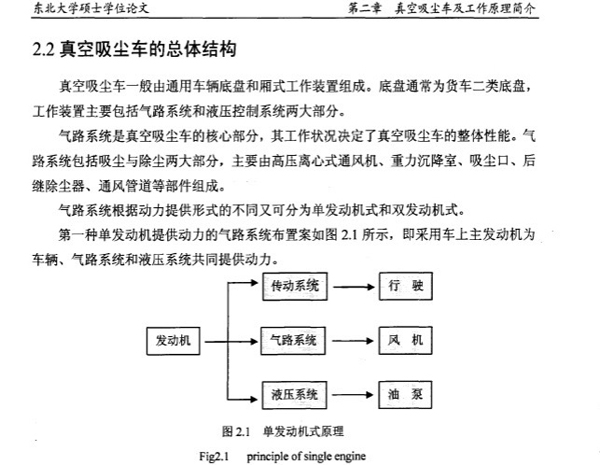
Screenshot of the second chapter of Li Bihong’s thesis on "the overall structure of vacuum cleaner".
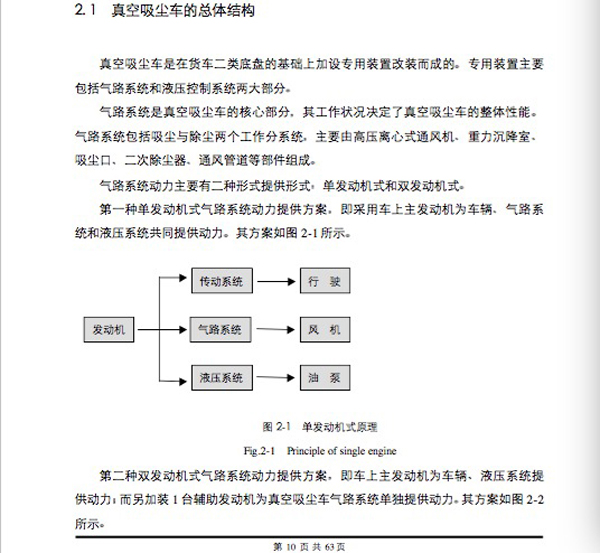
Screenshot of the second chapter of Sun Yong’s paper on "the overall structure of vacuum cleaner".
For another example, the first section of Chapter 2 of Li Bihong’s thesis "The overall structure of vacuum cleaner" reads: "The vacuum cleaner is modified by adding a special device on the second-class chassis of the truck. The special device mainly includes two parts: gas path system and hydraulic control system. The gas path system is the core part of the vacuum cleaner, and its working condition determines the overall performance of the vacuum cleaner. The gas path system includes two subsystems: dust collection and dust removal, which are mainly composed of high-pressure centrifugal fan, gravity settling chamber, dust suction port, secondary dust collector, ventilation pipeline and other components. There are two main forms of power supply for the gas path system: single engine type and double engine type. " Li Bihong’s paper also presents the principle of single engine and double engine in the form of legend.
Sun Yong wrote in the second section of the second chapter "Overall structure of vacuum cleaner": "Generally, vacuum cleaner consists of a general vehicle chassis and a van-type working device. The chassis is usually the second-class chassis of freight cars, and the working device mainly includes two parts: the gas path system and the hydraulic control system. The gas path system is the core part of the vacuum cleaner, and its working condition determines the overall performance of the vacuum cleaner. The gas path system includes two parts: dust suction and dust removal, and is mainly composed of high-pressure centrifugal fan, gravity settling chamber, dust suction port, subsequent dust collector, ventilation pipeline and other components. The gas path system can be divided into single engine type and double engine type according to the different power supply forms. " Sun Yong’s paper also presents the principle of single engine and double engine by drawing.
There is no difference between the above two paragraphs except that the first sentence and the last sentence are simply rewritten, and the "secondary dust collector" is changed to "subsequent dust collector", and other contents, including diagrams, are all the same.
Part of the contents of the fourth and fifth chapters of Sun Yong’s thesis are similar to some of the contents of the third chapter of Li Bihong’s thesis.
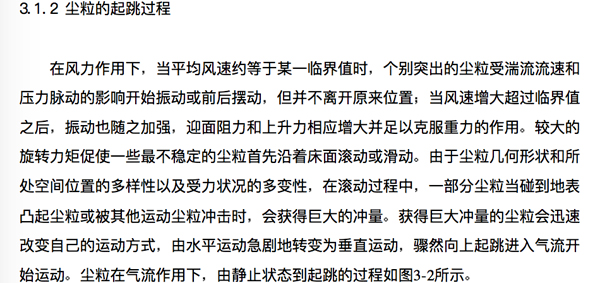
Screenshot of the content of the third chapter of Li Bihong’s paper "The take-off process of dust particles".
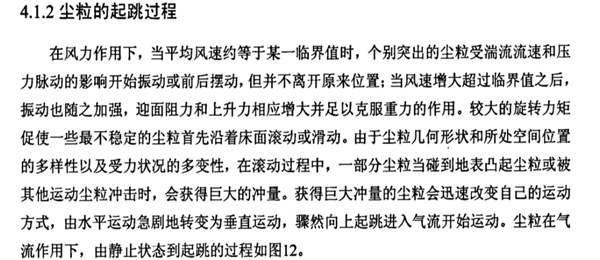
Screenshot of the fourth chapter of Sun Yong’s paper "The take-off process of dust particles".
For example, in the third chapter of Li Bihong’s paper, he wrote: "Under the action of wind, when the average wind speed is about equal to a certain critical value, individual prominent dust particles start to vibrate or swing back and forth under the influence of turbulent velocity and pressure pulsation, but they do not leave their original positions; When the wind speed increases beyond the critical value, the vibration will also be strengthened, and the head-on resistance and rising force will increase correspondingly enough to overcome the action of gravity. The larger rotating torque urges some of the most unstable dust particles to roll or slide along the bed surface first. Due to the diversity of geometric shapes and spatial positions of dust particles and the variability of stress conditions, during the rolling process, some dust particles will gain great momentum when they meet with raised dust particles on the surface or are impacted by other moving dust particles. Dust particles with great impulse will quickly change their movement mode, from horizontal movement to vertical movement, and suddenly jump up into the airflow to start moving. "
The fourth chapter of Sun Yong’s thesis also has a section on "the take-off process of dust particles". The specific content is as follows: "Under the action of wind, when the average wind speed is about equal to a certain critical value, individual prominent dust particles start to vibrate or swing back and forth under the influence of turbulent velocity and pressure pulsation, but they do not leave their original positions;" When the wind speed increases beyond the critical value, the vibration will also be strengthened, and the head-on resistance and rising force will increase correspondingly enough to overcome the action of gravity. The larger rotating torque urges some of the most unstable dust particles to roll or slide along the bed surface first. Due to the diversity of geometric shapes and spatial positions of dust particles and the variability of stress conditions, during the rolling process, some dust particles will gain great momentum when they meet with raised dust particles on the surface or are impacted by other moving dust particles. Dust particles with great impulse will quickly change their movement mode, from horizontal movement to vertical movement, and suddenly jump up into the airflow to start moving. "
The above two paragraphs are exactly the same.
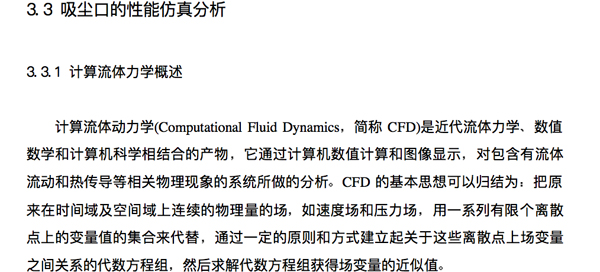
Screenshot of the content of the first section of chapter 3 of Li Bihong’s paper, "Performance simulation analysis of dust suction port".
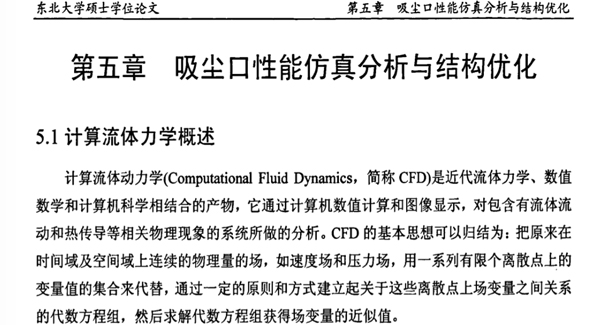
Screenshot of the fifth chapter of Sun Yong’s paper "Performance Simulation Analysis and Structure Optimization of the Dust Suction Port".
For another example, the third chapter of Li Bihong’s thesis mainly discusses "the performance simulation analysis of the dust suction port". This section begins with an overview of computational fluid dynamics, which mainly involves the application field of computational fluid dynamics, the simulation process of computational fluid dynamics, CFD software structure and so on. Among them, the first paragraph reads: "Computational Fluid Dynamics (CFD) is the product of the combination of modern fluid mechanics, numerical mathematics and computer science. It analyzes the system including fluid flow and heat conduction through computer numerical calculation and image display. The basic idea of CFD can be summed up as follows: replace the original continuous physical fields in time domain and space domain, such as velocity field and pressure field, with a series of sets of variable values at a limited number of discrete points, establish algebraic equations about the relationship between field variables at these discrete points through certain principles and methods, and then solve the algebraic equations to obtain the approximate values of field variables. "
The title of Chapter 5 of Sun Yong’s paper is "Performance Simulation Analysis and Structure Optimization of Dust Suction Nozzle", which also begins with "Overview of Computational Fluid Dynamics", including "Application Field of Computational Fluid Dynamics", "Simulation Process of Computational Fluid Dynamics" and "CFD Software Structure". The first paragraph reads: "Computational Fluid Dynamics (CFD) is the product of the combination of modern fluid mechanics, numerical mathematics and computer science. It analyzes the system including fluid flow and heat conduction through computer numerical calculation and image display. The basic idea of CFD can be summed up as follows: replace the original continuous physical fields in time domain and space domain, such as velocity field and pressure field, with a series of sets of variable values at a limited number of discrete points, establish algebraic equations about the relationship between field variables at these discrete points through certain principles and methods, and then solve the algebraic equations to obtain the approximate values of field variables. "
The two paragraphs listed above are verbatim.
Taking the fourth chapter of Li Bihong’s thesis and the sixth chapter of Sun Yong’s thesis as an example, it is found that the two chapters are similar in a large area.
For example, when discussing the spatial structure of the gravity settling chamber, Li Bihong wrote: "The gravity settling chamber of the vacuum cleaner is installed on the vehicle chassis, so the size of the vehicle chassis is a factor that affects the structural design of the settling chamber. The length, width and height dimensions of the gravity settling chamber shall not exceed the dimensions defined by the vehicle chassis. The size of gravity settling chamber should be arranged according to the principle of short, wide and long. If the settling chamber is too high, the dust particles on the upper part will settle to the bottom for a long time, and the dust particles will often be taken away by airflow before falling to the bottom. After the cross-sectional area of circulation is determined, the width increases and the height can be reduced. However, in the vacuum cleaner, the ash box and the settling chamber are integrated, and the height of the ash box must be reduced as much as possible on the basis of ensuring the requirements of solvent C. Lengthening the length of the settling chamber can improve the dust removal effect of the settling chamber. "
The sixth chapter of Sun Yong’s paper also has related discussion, specifically: "The gravity settling chamber of vacuum cleaner is installed on the vehicle chassis, so the size of the vehicle chassis is a factor that affects the structural design of the settling chamber. The length, width and height dimensions of the gravity settling chamber shall not exceed the dimensions defined by the vehicle chassis. The size of gravity settling chamber should be arranged according to the principle of short, wide and long. If the settling chamber is too high, the dust particles on the upper part will settle to the bottom for a long time, and the dust particles will often be taken away by airflow before falling to the bottom. After the cross-sectional area of circulation is determined, the width increases and the height can be reduced. However, in the vacuum cleaner, the ash box and the settling chamber are integrated, and the height of the ash box must be reduced as much as possible on the basis of ensuring the requirements of solvent C. Lengthening the length of the settling chamber can improve the dust removal effect of the settling chamber. "
The above two paragraphs are exactly the same.
In addition, in the "summary and discussion" section, the summary of Sun Yong’s paper is the same as that of Li Bihong’s paper, except that it does not contain the "subject innovation" of the latter’s paper.
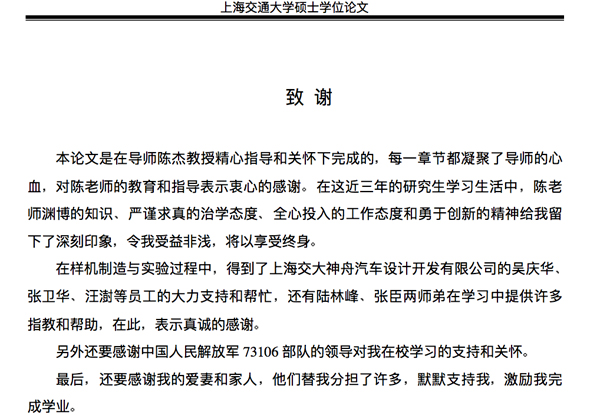
Screenshot of Li Bihong’s paper "Thanks".
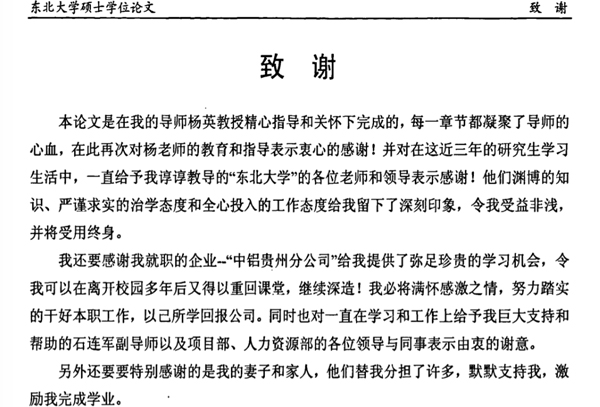
Screenshot of Sun Yong’s paper "Thanks".
More than half of the references are consistent, and the words "thanks" are the same.
The two papers are highly similar in content, and there are similarities in references and acknowledgements.
The Paper comparison shows that there are 34 references in Li Bihong’s paper and 33 references in Sun Yong’s paper. Among them, 26 of the 33 references in Sun Yong’s paper are consistent with those in Li Bihong’s paper.
Looking at the thank-you part again, Li Bihong wrote in the first paragraph of the paper "Thanks": "This paper was completed under the careful guidance and care of the tutor Professor Chen Jie, and each chapter embodies the painstaking efforts of the tutor and expresses heartfelt thanks to Mr. Chen for his education and guidance. In the past three years of postgraduate study and life, Mr. Chen’s profound knowledge, rigorous and truth-seeking attitude, dedicated work attitude and innovative spirit have left a deep impression on me, which has benefited me a lot and will be enjoyed for life. "
The first paragraph of Sun Yong’s paper "Thanks" reads: "This paper was completed under the careful guidance and care of my tutor, Professor Yang Ying, and each chapter embodies the tutor’s painstaking efforts. I would like to express my heartfelt thanks to Mr. Yang for his education and guidance again. And I would like to express my gratitude to all the teachers and leaders of Northeastern University who have been teaching me earnestly in the past three years of postgraduate study and life! Their profound knowledge, rigorous and realistic academic attitude and dedicated work attitude left a deep impression on me, which benefited me a lot and will be used for life. "
In the above two paragraphs, many adjectives are the same. At the same time, Li Bihong and Sun Yong thanked their wives and family members with the same words "shared a lot for me, silently supported me and inspired me to finish my studies".
Instructors suspected of plagiarizing papers: follow normal channels
Although Sun Yong’s thesis and Li Bihong’s thesis have a large area of similarities, both master’s degree theses have an Original Statement.
The authors of both papers said that their master’s degree thesis was the result of independent research work under the guidance of their tutors. Except where quotations and acknowledgements have been indicated, it does not include research results that have been published or written by others. Both of the original statements bear the author’s personal signature and date.
Due to the completion time of the paper, Sun Yong’s paper was nearly two years later than Li Bihong’s, and Sun Yong’s paper, which was completed in January 2008, was suspected of copying Li Bihong’s paper.
On the afternoon of April 2, The Paper called the Academic Committee of Northeastern University to verify the alleged plagiarism of Sun Yong’s paper. A staff member told The Paper that they had not received a formal report on this matter and could not give a specific result. If a formal report about academic misconduct or plagiarism is received, the investigation will be accepted.
Subsequently, The Paper contacted the Research Office of the School of Mechanical Engineering and Automation of Northeastern University, and the office staff also said that they were not aware of this matter and needed to know more.
The Paper also contacted Yang Ying, the instructor of Sun Yong’s thesis and a professor at the School of Mechanical Engineering and Automation of Northeastern University. "Just follow the normal (reporting) channels." Yang Ying said this on the phone.
The Paper learned from official website of Northeastern University that in April 2016, Northeastern University published the Detailed Rules for the Investigation and Punishment of Academic Misconduct in Northeastern University in official website, in which Article 14 stipulates that if a student has academic misconduct, the relevant functional departments of the school will give him corresponding punishment according to the relevant regulations on student management according to the identification opinions or reconsideration results. If academic misconduct is directly related to obtaining a degree, he can be treated as delaying the award of a degree, not granting a degree or revoking the degree according to law.