Taking stock of the rational anti-Japanese demonstrations across the country in 2012

Around "September 18th" last year, massive anti-Japanese demonstrations broke out all over the country. Observer Network helps you to review last year’s demonstrations.

On September 18th, demonstrations broke out in many mainland cities such as Guangzhou, Shenzhen, Nanjing, Changsha, Qingdao, Hangzhou, Xi ‘an and Dali, Yunnan. In Dongguan, Changsha, Qingdao and other cities, incidents such as confrontation between the police and the people and arson once occurred. The Japan Broadcasting Association said that there were anti-Japanese demonstrations in at least 52 cities. Kyodo News estimated that as many as 70,000 people took part in the demonstrations, which was the largest anti-Japanese demonstration among Japanese people since the normalization of diplomatic relations between China and China in 1972. NHK said that anti-Japanese demonstrations broke out in more than 100 cities a few days before September 18th last year.

On September 15, 2012, in front of the Japanese Embassy in China, a girl wiped the egg residue on the helmet for the armed police.

On September 15, 2012, in front of the Japanese Embassy in China, a girl wiped the egg residue on the helmet for the armed police.

On September 16th, an anti-Japanese demonstration took place in Guangzhou — — On the road in front of the Garden Hotel, a boy silently picked up the rubbish left by passers-by.

On September 18th, an anti-Japanese demonstration took place in Beijing. An old Beijing man surnamed Ma, who lives in the northeast of his hometown, picked up garbage during the demonstration, saying that "if you see too much garbage, you should pick it up", and the police on the side also came forward to help.

On September 16th, at the scene of the anti-Japanese demonstration in Xiamen, citizens covered the logo of an approaching Nissan car with the China flag, so that the owners could drive away safely.

On September 16, at the scene of the anti-Japanese demonstration in Xiamen, the citizens covered the logo of the coming Nissan car with the China flag to let the owner drive away safely.


On September 16th, an anti-Japanese demonstration took place in front of the Japanese Embassy in Beijing.


On September 16th, an anti-Japanese demonstration took place in front of the Japanese Embassy in Beijing.

On September 16th, an anti-Japanese demonstration took place in front of the Japanese Embassy in Beijing. 

On September 16th, an anti-Japanese demonstration took place in Chengdu.

On September 16th, an anti-Japanese demonstration took place in Chengdu.

On September 16th, an anti-Japanese demonstration took place in Chengdu.

On September 16th, an anti-Japanese demonstration took place in Chengdu.

Turn the page to see the scene map of the parade around.

 

Hong kong anti-Japanese demonstration

Anti-Japanese demonstrations in Hong Kong.

On September 16th, Hong Kong staged an anti-Japanese demonstration.

Beijing anti-Japanese demonstration

Beijing anti-Japanese demonstration

Beijing anti-Japanese demonstration

On September 16th, an anti-Japanese demonstration took place in front of the Japanese Embassy in Beijing.


Beijing anti-Japanese demonstration

On September 16, a water bottle was thrown by protesters in front of the Japanese Embassy in Beijing.

The argument of nationalization of Diaoyu Island was first thrown by Japanese right-wing forces, and Shintaro Ishihara, as a key figure, played a key role in this farce. Japanese Prime Minister Noda Yoshihiko also publicly expressed his support and joined. The theory of purchasing islands directly led to the sharp deterioration of Sino-Japanese relations. On the morning of September 10, 2012, the Japanese government held a cabinet meeting and decided to "nationalize" Diaoyu Island, North Island and South Island with 2.05 billion yen from the so-called "land owners". On September 11th, we signed a "sales contract" with the so-called "landowner" of Diaoyu Island.


There were more than 10,000 participants in the anti-Japanese demonstrations in Guangzhou, and the procession broke into the building area where the Japanese Consulate General was located. More than 10,000 people took part in the parade in Shenzhen. Since the Diaoyu Islands were "nationalized" on September 11th, 2013, demonstrations in Beijing and Shanghai have lasted for more than six days.

On September 16, Shenzhen, the scene of the anti-Japanese demonstration.

On September 16, Shenzhen, the scene of the anti-Japanese demonstration.

On September 16, a large-scale anti-Japanese demonstration was held in Shenzhen, and the armed police maintained order at the scene.

On September 16, a large-scale anti-Japanese demonstration was held in Shenzhen, and the armed police maintained order at the scene.

On September 16th, Shanghai anti-Japanese demonstration scene map.

"One billion young people and one billion soldiers, the national humiliation is not for children and grandchildren."


On September 16th, an anti-Japanese demonstration took place in Shanghai.

On September 16th, an anti-Japanese demonstration took place in Shanghai.

On September 16, Shanghai, the scene of the anti-Japanese demonstration.

On September 16, near the Japanese Consulate in Shanghai, a policeman tried to put out the flame of the Japanese flag lit by protesters.

On September 16, near the Japanese Consulate in Shanghai, a policeman tried to put out the flame of the Japanese flag lit by protesters.

Quanzhou anti-Japanese demonstration

On September 16th, Quanzhou, the scene of the anti-Japanese demonstration.

On September 16th, an anti-Japanese demonstration was held in Foshan, Guangdong.

On September 16th, an anti-Japanese demonstration was held in Foshan, Guangdong.

Turn the page to see more reviews of anti-Japanese demonstrations.

 

On September 16th, an anti-Japanese demonstration took place in Guangzhou — — On the road in front of the Garden Hotel, a boy silently picked up the rubbish left by passers-by.

On September 16th, an anti-Japanese demonstration took place in Guangzhou — — On the road in front of the Garden Hotel, a boy silently picked up the rubbish left by passers-by.

On September 16, a girl holding a slogan outside the Japanese Embassy in China, Beijing.

On September 16, a girl holding a slogan outside the Japanese Embassy in China, Beijing.

A citizen of Xi 'an stood at the intersection with a card to remind the public that "the Japanese car will turn around when it hits the car ahead".

A citizen of Xi ‘an stood at the intersection with a card to remind the public that "the Japanese car will turn around when it hits the car ahead". 

On September 16th, during the anti-Japanese demonstration in Guangzhou, a woman leaned over and put the flowers that had been pushed to the ground back into the flower bed.

On September 16th, during the anti-Japanese demonstration in Guangzhou, a woman leaned over and put the flowers that had been pushed to the ground back into the flower bed.

By 12: 00 on September 16th, 2012, there were more than 44 million Weibo articles about Diaoyu Island on Sina Weibo alone. Faced with the tide of public opinion on the Internet and on the streets, Weibo, an official of local government information offices and public security system, voiced their voices one after another, calling on citizens to express their patriotic demands peacefully and rationally according to law, and said that they would seriously deal with illegal and criminal acts that took the opportunity to make trouble. 

On September 16th, an anti-Japanese demonstration was held in Guangzhou.

On September 16th, an anti-Japanese demonstration was held in Guangzhou.

On September 16th, an anti-Japanese demonstration was held in Huizhou, Guangdong.

On September 16th, an anti-Japanese demonstration was held in Huizhou, Guangdong.

On September 16, Wanzhou, the scene of the anti-Japanese demonstration.

On September 16th, at the scene of the anti-Japanese demonstration in Wanzhou, "Wan Li’s Great Wall has one billion soldiers, and the more Mayangyao entered Tokyo".

On September 16th, Fuzhou, Fujian Agriculture and Forestry University, the "Diaoyu Island" sign was erected in the school pond.

On September 16th, Fuzhou, Fujian Agriculture and Forestry University, the "Diaoyu Island" sign was erected in the school pond.

On September 16, Hangzhou, the scene of the anti-Japanese demonstration.

On September 16, Hangzhou, the scene of the anti-Japanese demonstration.

On September 10th, 2013, eight Chinese Marine Police formations, including 2350, 1115, 1126, 2112, 2113, 2146, 2506 and 2151, cruised in the territorial waters of the Diaoyu Islands. This is the eighth time that China Marine Police has organized a fleet of ships to cruise in the territorial waters of Diaoyu Island since the reorganization of the State Oceanic Administration and the enforcement of maritime rights protection in the name of China Marine Police.

According to the data released by the State Oceanic Administration of China on the 10th, since the Japanese government announced the nationalization of the Diaoyu Islands in September last year, China’s law enforcement vessels have patrolled around the Diaoyu Islands for 59 times, with one joint air and sea cruise in the territorial waters of the Diaoyu Islands. The longest continuous cruise in the territorial waters is 28 hours and 36 minutes, and the nearest distance is 0.28 nautical miles.


On September 16th, an anti-Japanese demonstration was held in Chengdu.

The scene of the anti-Japanese demonstration in Chengdu on September 16th.

On September 16th, an anti-Japanese demonstration took place in Chengdu.

(Comprehensive news from China Youth Network, Netease, Phoenix Network, etc.)
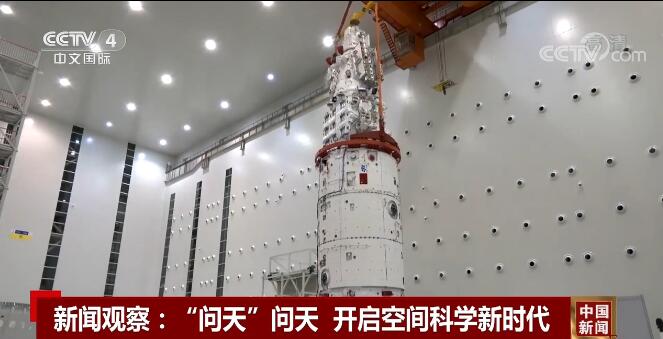
China opens a new era of space science.

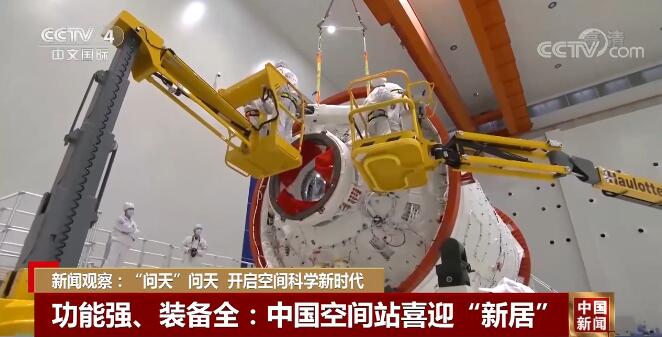
CCTV News:As the first scientific experiment module of China Space Station and an important part of the National Space Laboratory, "Asking for Heaven" will provide more space for astronauts to work and live in orbit, and also provide a larger platform for space science experiments and applications.

Powerful function and complete equipment: China Space Station welcomes "new house"

With a total length of 17.9 meters and a maximum diameter of 4.2 meters, the candlestick experimental module is the largest single-cabin active aircraft in China at present. It is composed of a working module, an airlock module and a resource module, and each module undertakes different functions. In the working cabin, eight experimental cabinets are equipped, which can support space life science research and some corresponding variable gravity scientific experiments in the future. This cabin also has a sleeping area and a sanitary area for astronauts to live, exercise and eat.

Liang Xiaofeng, chief designer of the overall responsibility of the experimental cabin of the Fifth Academy of Aerospace Science and Technology Group:There are three sleeping areas in the core cabin and three sleeping areas in the experimental cabin. This design is mainly for six astronauts to live together in orbit and provide them with more spacious work (space), including living space.

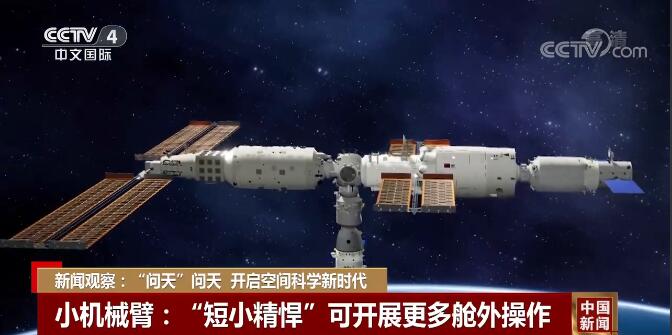
Small manipulator: "short and pithy" can carry out more extravehicular operations.

There is also a set of 5-meter-long small mechanical arm outside the airlock of the candlestick experimental module. This 7-degree-of-freedom mechanical arm is compact, high precision and more precise in operation. In the future, the forearm can also form a 15-meter-long combined arm with the big arm of the core module to carry out more extravehicular operations in the three-module assembly of the space station.

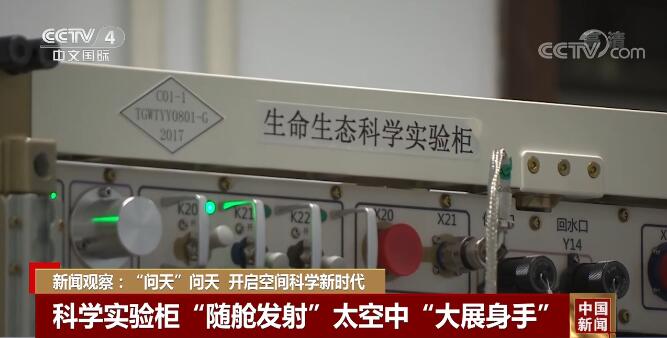
The scientific experimental cabinet "launches with the cabin" and "displays its skills" in space

There are also a number of mysterious cabinets that enter space with the Inquisition Experimental Module — — The scientific experimental cabinets mainly include 14 scientific experimental cabinets in a sealed cabin, an extravehicular exposure experimental platform and a common-orbit survey telescope, which support the scientific research on space astronomy, space life science and biotechnology, microgravity basic physics and so on.

Zhong Hongen, Deputy Chief of Space Application System of Manned Space Engineering, Researcher of Space Application Center of Chinese Academy of Sciences:For the first time, the international advanced scientific experimental cabinet was adopted to build a large-scale experimental facility, and the 500 kg scientific experimental facility is equivalent to the size of a medium-sized satellite.

According to reports, the Kaitian experimental cabin has deployed scientific experimental facilities such as life ecology experimental cabinets, biotechnology experimental cabinets, scientific glove boxes and low-temperature storage cabinets, variable gravity scientific experimental cabinets, and extravehicular exposure test devices.

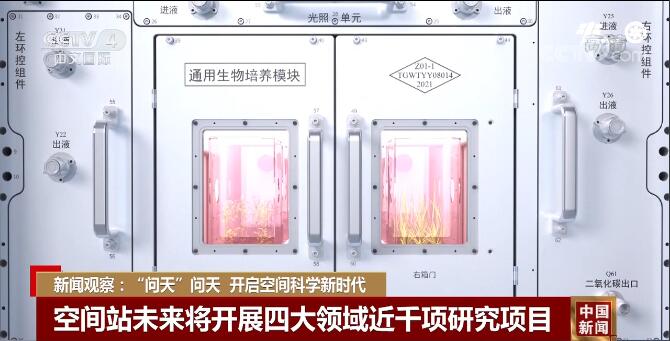
The space station will carry out nearly 1,000 research projects in four major fields in the future.

China Space Station will be in orbit for more than 10 years after its completion. Experts said that in the future, China Space Station will carry out 65 research projects in four major fields, including space life science and human body research, microgravity physics science, space astronomy and earth science, and new space technology and application, including nearly 1,000 research projects, to explore a series of scientific problems faced by human beings in long-term space survival, which will comprehensively open a new era of space science research and application in China.