Constructing a comprehensive three-dimensional traffic corridor in the Yangtze River Economic Belt, multimodal transport and expanding the "width" of the Yangtze River
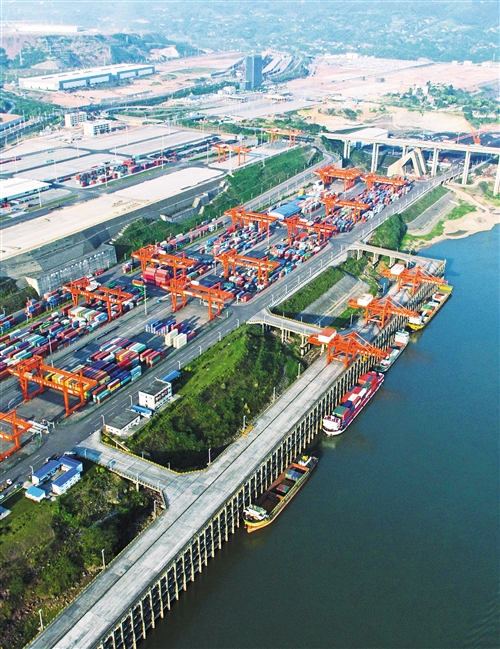
The picture shows Chongqing Orchard Port, the China-Europe International Freight Corridor and the Yangtze River Golden Waterway are "seamlessly connected". Xinhua News Agency reporter Liu Yushe
The provinces and cities along the Yangtze River Economic Belt have further deepened the information exchange and business cooperation among shipping, port and cargo enterprises, and promoted the development of "ship-port cargo, water-rail and door-to-door logistics" throughout the Yangtze River, which has significantly enhanced the multimodal transport function of important ports and general ports in the Yangtze River Economic Belt and realized river-sea transport, iron-water transport and public-water transport.
In the cold winter, in Zengzhou Shipyard in Zhoushan, Zhejiang Province, a "big guy" is doing the final "dressing up" and preparing to perform a new mission. "It’s called ‘ Jianghai Zhida No.1 ’ For the first time in China, the bulk carrier manufactured by adopting the river-sea direct specification has completely changed the defects that the sea-going ships could not run into the river and the river-going ships could reach the estuary. " Li Dan, deputy general manager of Zhejiang Zengzhou Shipbuilding Co., Ltd., pointed to this "big guy" and told reporters: "In March this year, it will be officially put into operation, and container ships and tankers with the same river-sea direct function will also become their work in the near future. ‘ Little friend ’ 。”
Zhoushan, Zhejiang Province, which is famous for its island and prospered because of its port, is located at the intersection of the North-South Maritime Passage and the Yangtze River Golden Waterway. The construction of "Jianghai Direct No.1" is only a breakthrough point for it to accelerate the construction of a comprehensive three-dimensional traffic corridor in the Yangtze River Economic Belt. In fact, the exploration of river-sea combined transport, molten iron combined transport and public water combined transport in practice is expanding the "width" of the Yangtze River.
Jianghai Lianyun Changdayi Road
"If the Yangtze River Economic Belt wants to develop, we must first build a logistics economic belt. In other words, logistics must be strung together, so as to promote the relevance of the whole regional construction. " According to Xu Xiaoyue, deputy director of Zhejiang Zhoushan Islands New District Management Committee and deputy mayor of Zhoushan City, the establishment of Zhoushan River-Sea Intermodal Service Center is to use the geographical advantages of Zhoushan Tongjiang and Dahai to solve the problem of river going to sea and sea entering the river, and connect the whole Yangtze River in series from Chongqing in the upper reaches, Wuhan in the middle reaches and Nanjing in the lower reaches.
Not disappointed, with the help of the platform of Jianghai Intermodal Service Center, Zhoushan City has strengthened its docking with important ports along the Yangtze River, accelerated the strategic layout of bulk cargo along the Yangtze River, and signed cooperation agreements with Wuhan Intermodal Exchange, Maanshan Iron and Steel Group and Changhang Ro-Ro. Negotiate and dock with Wuhan Xingang Committee, China Airlines Company under Wuhan Port Development Investment and Wuhan Institute of Technology on the container project of river-sea combined transport; Reached a cooperation with Chongqing Port Group on river-sea combined transport of iron ore, containers and cold chain & HELIP; … The "gold content" of the golden waterway of the Yangtze River is constantly improving.
Now, by clicking on Zhoushan’s public information platform of river-sea combined transport, we can see that the goods coming from "the sea" are rapidly "swimming" in the Yangtze River basin. The bulk carrier Runguang No.3, which started from the 20,000-ton unloading expansion terminal of Laotangshan Phase III and loaded with nearly 15,000 tons of soybeans, left Hong Kong at 11: 00 on January 22 and headed for Taizhou, Jiangsu. The bulk carrier "Baohang No.18", which loaded 50,000 tons of iron ore at No.5 berth in Majishan Port Area of Baosteel Phase II, also had a big belly, and sailed for the destination port of Nanjing &hellip from 10: 00 on January 21st. … The data shows that in 2017, the combined transport volume of the Yangtze River and the sea is expected to reach 1.41 billion tons, accounting for about 56% of the cargo throughput of the Yangtze River trunk line.
Of course, there is still potential to tap the river-sea combined transport, a 20,000-ton big guy — — "Jianghai Direct No.1" is one of the potential points. "The tonnage of inland ships in the Yangtze River is generally below 10,000 tons, with a flat bottom and shallow draft, which is not stable enough after entering the sea; Because of the bridge design and deep draft, seagoing ships can’t enter the river. This means that it will take two times to load and unload during transportation, which is not only time-consuming, but also the goods will be damaged. Jianghai direct ships only need to be loaded and unloaded once, which greatly improves the transportation efficiency and reduces the logistics cost. One ton can save twenty or thirty yuan. " The account calculated by Suo Xudong, deputy director of Zhoushan Port and Shipping Administration Bureau of Zhejiang Province, shows that the smoothness of river-sea combined transport is worth looking forward to.
Land-sea linkage is once again deep
On December 25, 2009, Zhoushan Sea-crossing Bridge was opened to traffic on this day. Since then, Zhoushan has been "bordering" with the mainland all the way to the west, ending the history of being alone at sea. The huge photos in the urban exhibition hall of Zhoushan Archipelago New Area in Zhejiang Province "collect" five sea-crossing bridges, namely cengang, Xiangjiaomen, Taoyaomen, Xihoumen and Jintang, which are full of inexhaustible momentum.
Nowadays, on the coast of the East China Sea, piers stand on the sea, and there is another "sea passage" — — The main passage of Zhoushan Port in Ningbo is slowly spreading out. The starting point of the main channel is Fuchi Island, which connects the existing Ningbo-Zhoushan Expressway. After crossing the Fuchimen Waterway, the Fuqimen Bridge is connected with the south side of cengang Zengci Village, and then journey to the south crosses Zhoushan Island and enters the sea again. Daishan Cross-sea Bridge takes the "hands" of Zhoushan Island and Daishan Island, and finally reaches Yushan Island through Yushan Bridge. "Each of these bridges has its own special mission." Yu Shubo, director of the Development and Reform Commission of Zhoushan City, Zhejiang Province, said with emotion.
The Fuchimen Bridge, which is scheduled to be completed by the end of this year and opened to traffic in June next year, will effectively divert the flow of the Yongzhou Expressway and deepen the land-sea linkage. At present, the prototype has appeared; The Daishan Cross-sea Bridge, which is expected to be completed and opened to traffic in 2021, is the "dream messenger" of Daishan people. In the past, Daishan people were always trapped on the island by wind, waves and fog for nearly 50 days every year, and it is more common to queue up at ferry terminals on holidays. The construction of Daishan Cross-sea Bridge has changed this situation; Yushan Bridge is a branch line of the main channel project of Zhoushan Port in Ningbo. It is planned to be completed and opened to traffic by the end of this year, and it will become the only land channel connecting Zhoushan International Green Petrochemical Base.
Some experts pointed out that the construction of the main channel will greatly optimize the land transportation system between Zhoushan Port in Ningbo and the Yiwu-Ningbo open channel, and turn Zhoushan into a transportation hub from the traffic terminal, which is of great significance for further improving the location conditions of Zhoushan Islands New District, driving the construction of the core port area of river-sea combined transport and supporting major industries, promoting the integration of Zhoushan Port in Ningbo, and realizing port linkage, port-city linkage and land-sea overall planning.
In the long run, this is a longer "parabola": from the main passage of Zhoushan Port in Ningbo to the north, connecting Yangshan and finally connecting with Shanghai. By then, Shanghai Port and Ningbo Zhoushan Port will be integrated into one, forming an annular road network along the eastern coast of the Yangtze River Delta region, which will make the market radiation range of the Yangtze River Basin wider.
Two-way opening goes further.
A series of actions of Zhoushan, the "dragon head", have a heart along the Yangtze River. Huangshi New Port is connected by multimodal transport of hot metal and water, and the seamless connection of public, iron and water infrastructure has been realized, and the radiation capacity of the port has expanded from about 100 kilometers in general to more than 1000 kilometers along the railway line; The container freight train of "COSCO Shipping" is full of goods and leaves from the station of the first phase of Yangluo Port’s iron-water combined transport project. The whole transportation time is about 7 days shorter than that of the traditional all-water mode. At present, through the construction of a comprehensive three-dimensional traffic corridor along the river, the development of hot metal, public water and river-sea combined transport has become a hot spot, and it is the focus.
What’s good about multimodal transport? This has to find the answer from Wen Xinxiang, deputy director of the Yangtze River Navigation Administration Bureau of the Ministry of Transport. It is reported that Xinxiang said that in terms of transportation capacity, a 5000-ton ship is equivalent to 100 cars and 100 railway wagons. If the general ledger is calculated, the annual freight volume of the Yangtze River trunk line is equivalent to about 70% of the national railway freight volume; In terms of cost, water transportation is only about 1 minute and 5 cents per ton-kilometer, the railway is close to 0.3 yuan, and the highway is the highest to 1.1 yuan. "That is to say, the price of tons of kilometers of water transportation is cents, the price of railways is cents, and the price of highways is yuan yuan. The difference is still very big." Not only that, in terms of energy consumption and emissions, water transport is much smaller and lower than roads and railways. It is self-evident that it is necessary to vigorously build the golden waterway of the Yangtze River and attract more suitable water sources to transfer to waterways.
However, if you are happy to see the advantages, you must find the problems clearly. At present, most of the multimodal transport in the Yangtze River basin still stays in the simple superposition of transport segments, and the "linkage" of transport organizations in documents, dispatching and business connection is still very lacking. The development model of multimodal transport in the Yangtze River Economic Belt needs to be innovated urgently. After finding the problem, we should start to solve it. At the end of last year, the Yangtze River Port and Shipping Logistics Alliance Full-course Logistics Professional Committee was established in Wuhan, aiming at further deepening the information exchange and business cooperation between shipping, port and cargo enterprises, promoting the development of "ship-port cargo, water and rail, door-to-door" full-course logistics in the Yangtze River, and significantly enhancing the multimodal transport function of important ports and general ports in the Yangtze River Economic Belt, which is a "prescription".
Multimodal transport makes the Yangtze River change from one-way opening in the West and Middle East to two-way opening, connecting the inland and the world, and it will face a broader and more dynamic market. (Economic Daily China Economic Net reporter Niu Wei)