Foreign media pay attention! The investigation of "TongRumen" is coming to an end. How big will the trouble be?
CCTV News:On August 7th, the Central Radio and Television General Station’s "International Sharp Review" broadcast titled "The investigation of" TongRumen "is coming to an end. How much trouble will it be? The article was reprinted by many overseas media.
From 7 to 9 August, French LCF Radio facebook account, German-Chinese Report website, Spanish Radio International website, Italian Radio We website (facebook, twitter), Portugal Lisbon Rainbow FM website (facebook), Portugal Global Iberian client, Brazil Sao Paulo World Radio and Television website (facebook), Many overseas media, such as facebook, Turkish Economic Observation Network, Jordan Global Radio facebook account, Chinese PT portal, Chinese Headline APP, Portuguese New Newspaper APP(facebook, twitter), European Union Chinese website, Europe-China United Times website, Africa Times website, West Africa online website, Japanese Chinese business website, and Greek China website, have forwarded them one after another. From August 8 to 10, this article was also published and forwarded by Hong Kong Ta Kung Pao, wenhui network and Hong Kong Business Daily. The main reports are as follows:
US President Trump, who ruled the country by Twitter, once again pushed himself to the forefront with Twitter on the 5th, denouncing the report of "fake news" on his beloved eldest son Donald Trump Jr as "a complete fabrication", and revealed that in 2016, Trump Jr. met a Russian female lawyer at Trump Tower in new york, with the aim of obtaining information from his political opponents, which was "completely legal and a consistent practice in politics".
As early as more than a year ago, when The New York Times first disclosed the meeting, Trump Jr. made it clear that they were discussing a project on the adoption of Russian children that the US government had stopped. He also went to the closed-door hearing of Congress to ensure that Trump himself did not know about the meeting, and that the presidential campaign had nothing to do with Russia. However, a few months later, the media revealed that this statement was drafted by President Trump himself.
Now, 13 months after Trump Jr.’ s statement, President Trump actually admitted on Twitter that the meeting was to get the black materials of his opponent from Russian lawyers. People who are used to Trump’s reneging performance can’t help but be shocked when they see such a reversal! Ian Bremmer, chairman of Eurasia Group, the world’s largest political risk consulting company, concluded that either President Trump lied or the liar was Trump Jr.
The mainstream media in the United States and Europe have pointed out that the meeting two years ago happened to be an important link involved in the investigation of "TongRumen" conducted by Mueller, the special prosecutor of the US Department of Justice. With the approaching mid-term elections in the United States, the investigation of "TongRumen", which has been going on for more than a year, is drawing to a close. On the 5th, mainstream media in the United States, including Washington post, CNN and Associated Press, reported that the investigation of "TongRumen" is likely to harm people around President Trump, especially Trump Jr., the eldest son who planned and participated in the meeting.
Legal experts believe that Trump Jr.’ s contact with foreigners in order to obtain black materials from political opponents violates the relevant provisions of the US election law and may even be suspected of "conspiracy against the United States". At the beginning of this year, when Bannon, Trump’s strategist and former chief strategist of the White House, broke with Trump, he once said that the meeting was a treason. Nowadays, everyone has speculated whether such a heavy accusation has entered Muller’s "TongRumen" investigation list.
In fact, Mana Ford, another important figure in that meeting and former general manager of Trump’s campaign team, is now in deep jail because of many charges such as "conspiracy against the United States", and the case will be heard next month. At present, Manafort has been accused by the special prosecutor Mueller team for economic problems such as bank fraud and tax evasion, and the case has entered the trial stage. Although Mana Ford refused to plead guilty, Rick Gates, his former business partner and now a federal tainted witness, admitted to the jury on the 6th that he had helped Mana Ford commit crimes such as bank and securities fraud, and described the criminal process in detail. Earlier, Gates and Manafort were charged with money laundering and "conspiracy against the United States". He was dealt with separately because he all pleaded guilty and became a tainted witness.
Can Manafort continue to be hard-pressed and wait for Trump to exercise his presidential power in the future to give him Amnesty? Or will you plead guilty and become an important tainted witness of "TongRumen"? This is not only a drama that the media all over the world pay attention to, but also a trial that makes President Trump very worried.
Trump tweeted at the beginning of the trial that Mana Ford was wronged, saying that Mana Ford was once the right-hand man of former President Reagan and other Republican leaders, but now he was treated unfairly by the Mueller team, which was worse than that suffered by Alfonse Capone, the number one "public enemies" in the United States. He also questioned the evidence of communication with Russia and demanded that Attorney General sessions immediately terminate the investigation of "communication with Russia". Of course, the White House had to remedy afterwards that the president’s tweet was not giving orders, but expressing his views.
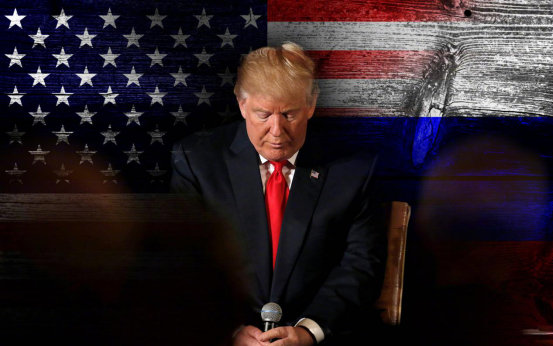
Trump’s aversion to the "TongRumen" investigation has a long history. Whenever it comes to the investigation of "TongRumen", he is always labeled as "witch hunting" and "fraud". According to American media statistics, in the first seven months of this year, he sent out 84 such labels.
At the same time, Michael Cohen, a former private lawyer who has handled all kinds of bad things and worries for Trump for many years, is now being investigated for being involved in bank and tax fraud activities, especially for possibly violating the relevant regulations of the election law. The US media disclosed that FBI agents had obtained a batch of audio clips in Cohen’s apartment, office and hotel room, among which Cohen secretly recorded a conversation with Trump, showing that they had discussed it with former Playboy magazine girl McDougall before the election, asking her to conceal her ulterior relationship with Trump. According to reports, Cohen also confirmed to the Muller investigation team that Trump met with Russian lawyers and got Trump’s approval in advance. This remark was immediately attacked by Trump’s current lawyer and former mayor of new york, Giuliani, calling Cohen a "pathological liar". Cohen, who used to talk about blocking bullets for Trump, has now turned against him. How much deadly black material is there in the conversation he secretly recorded?
As the investigation of "TongRumen" enters the final stage, President Trump, who is on vacation at the New Jersey Golf Course, is faced with a difficult choice: whether to take the initiative to accept the question of special prosecutor Muller or wait for Muller’s summons to answer the question? Will this duplicitous American president, who is good at picking things up, play another trick to divert public attention and cover up his weak life? Or, did Muller offer a fatal blow to Trump when former FBI Director Komi made a move against Hillary?
A number of overseas media forwarded "International Sharp Review" articles:
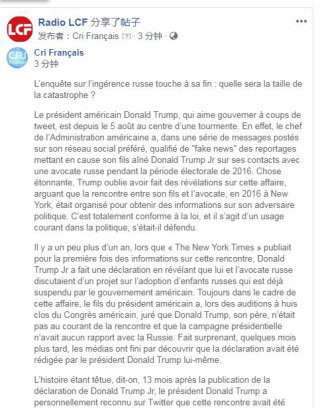
Facebook account of French LCF radio station was forwarded on August 7, 2018.
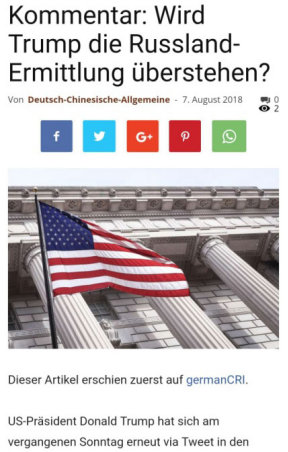
The German-Chinese Report website was forwarded on August 7, 2018.
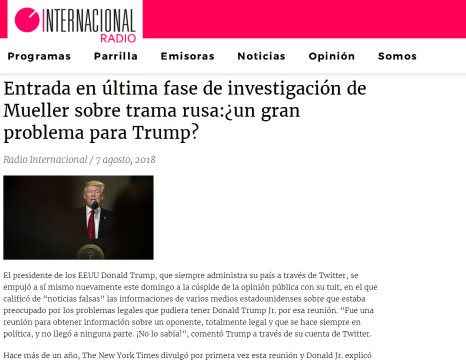
Radio Spain International website forwarded on August 7, 2018
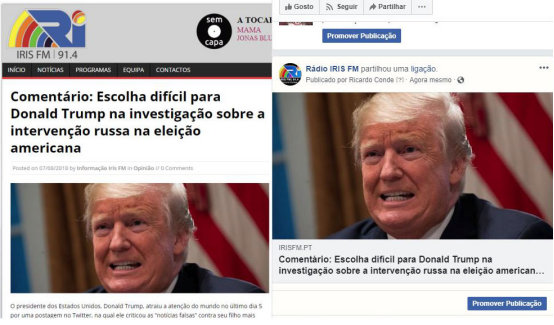
Portugal Lisbon Rainbow FM website (Facebook) forwarded on August 7, 2018.
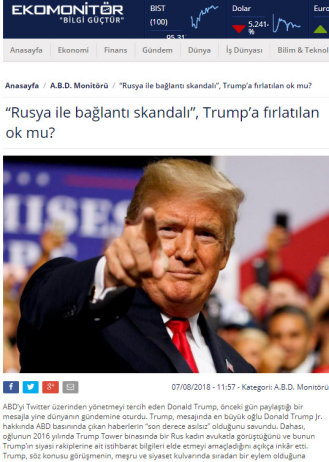
Turkish Economic Observer Network forwarded on August 7, 2018
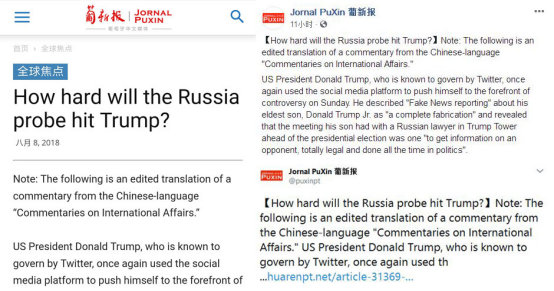
Portuguese news APP(facebook, Twitter) forwarded on August 8, 2018.
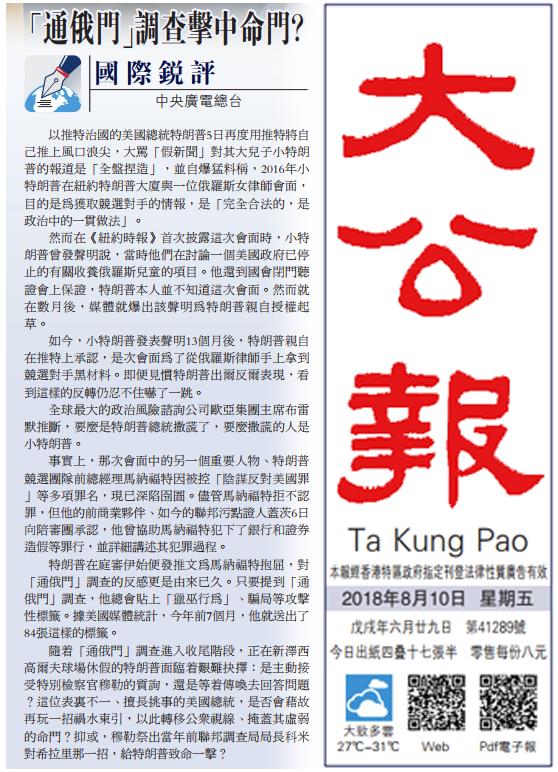
Hong Kong Ta Kung Pao was published on August 10, 2018
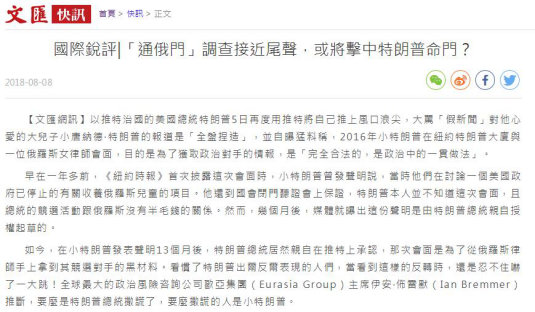
Wenhui network, Hong Kong forwarded on August 8, 2018.
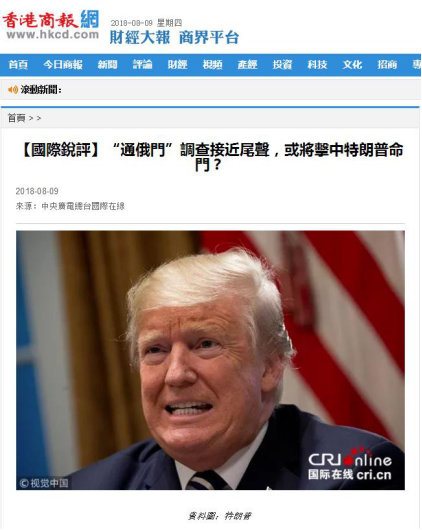
Forward by Hong Kong Business Daily on August 9, 2018