Beijing announces the settlement method of points, and moving to the suburbs can accelerate the settlement.
On August 11th, the "Administrative Measures for Settlement of Points in Beijing (Trial)" was officially released and will be implemented next year. This is a major reform of Beijing’s household registration management system, which will establish an open and fair settlement channel for ordinary workers who have been legally and stably employed and legally settled in Beijing for a long time, enhance their sense of urban integration and belonging, and share the fruits of harmonious social development.
What considerations does Beijing have in the process of formulating this policy? Are the settlement conditions as "the strictest in history" as the outside world has said? Does it mean that it is easier to settle down after the introduction of the policy?
"In formulating policies, we should not only solve the problem of qualified ordinary workers settling down, promote social harmony, but also grasp the effective connection and balance between the points settlement policy and the population control target, and at the same time provide human resources guarantee for upgrading the core functions of the capital. The final document is a comprehensive balance after considering multiple conditions." Professor Li Guoping, president of Peking University Capital Development Research Institute who participated in policy formulation, said.
Give extra points to encourage employment and residence in the suburbs.
"The so-called settlement of points means that by establishing an index system, the conditions for holders of residence permits to apply for settlement are quantified, and each index is given a certain score. Those who have reached the specified score can apply for permanent residence in Beijing." The relevant person in charge of the Beijing Development and Reform Commission introduced.
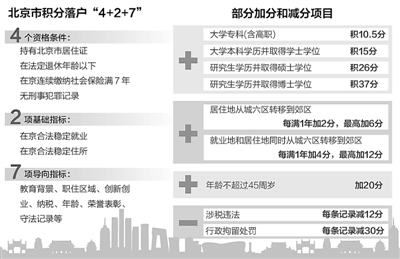
The index system of settlement of points in Beijing is designed around the strategic positioning of the capital city and the needs of development at this stage, mainly for qualified ordinary workers, focusing on solving the problem of settlement of people who have been in Beijing for a long time and have strong employability. Simply put, the overall policy framework can be summarized as "4+2+7". That is, four qualifications: those who hold a residence permit in Beijing, are below the statutory retirement age, have paid social insurance for 7 years in Beijing, and have no criminal record; Two basic indicators: legally stable employment and legally stable residence; Seven guiding indicators: including education background, occupation and residence area, innovation and entrepreneurship ability, tax payment, age, honor recognition, law-abiding record and so on.
In addition to Beijing, Shanghai, Tianjin, Guangzhou and Shenzhen have introduced the points system. The reporter compared the provisions of several cities on the conditions of "entry" and found that Beijing’s approach was not as "the strictest in history" as the Internet said. For example, in terms of the applicant’s age, Guangzhou requires 20-mdash; 45 years old, Shenzhen requires 18-mdash; 48 years old, while Beijing stipulates that the statutory retirement age is below, which relatively expands the range of people who can apply for the settlement of points, which is more in line with the original intention of policy formulation. For another example, Shanghai requires to pay social security for seven years and must have intermediate or above professional titles or professional qualifications of technicians, while Beijing does not implement "one-vote veto" on professional titles and professional qualifications.
"As far as entry qualifications are concerned, Beijing should be regarded as the middle level among several megacities." Professor Li Guoping said that under the premise of implementing national requirements, Beijing’s implementation measures highlighted basic requirements such as legal and stable employment and stable residence, and focused on solving the problem of eligible ordinary workers settling down. At the same time, a number of guiding indicators have been set. For example, Beijing, as a national science and technology innovation center and cultural center, has a high demand for personnel in related fields, so the policy sets educational background and innovation and entrepreneurship indicators. For another example, in order to orderly relieve the functions of non-capital, promote the optimization of urban spatial layout, give extra points to encourage employment and residence in the suburbs. According to the regulations, if the applicant’s residence is transferred from the six districts of the city to other administrative regions, 2 points will be added for each full year, with a maximum of 6 points. If the applicant’s place of employment and residence are transferred from the six districts of the city to other administrative regions, 4 points will be added for each full year, with a maximum of 12 points.
You can only settle down after publicity to prevent fraud.
According to reports, Beijing’s point settlement policy implements "total control+voluntary application". Through the method of "applying first and marking later", the settlement score will be determined through comprehensive calculation and overall research according to the actual size of applicants and the requirements of annual population control targets.
Li Sufang, deputy director and spokesperson of the Beijing Municipal Development and Reform Commission, said that the policy of settlement of points concerns the vital interests of the masses, and the operation and implementation of the policy will run in the sun, reducing the space for discretion through institutionalized regulations.
After the introduction of the points management measures, the relevant departments will also issue implementation rules to clarify the identification standards of various indicators and the specific operational procedures for policy implementation. Generally speaking, it needs to go through the applicant’s application, unified declaration by the unit, departmental linkage review, unified publicity to the public, etc., and finally determine the settled personnel before going through the relevant settlement procedures. In order to facilitate the handling to the greatest extent, the applicant unit shall make a unified declaration to the human resources and social security department of the administrative region where it is located, and use the information processing channel to implement online handling. Once a year, a period of time will be determined for centralized application. If the application does not reach the settlement score in that year and the application continues in the next year, the applicant only needs to choose to update the changed information, and the original score will remain unchanged for the unchanged information.
All relevant departments will strictly review the procedures. The information submitted by the applicant will be reviewed and cross-checked by the municipal and district human resources and social departments and a number of municipal departments to ensure the authenticity of the information. Finally, it will be summarized into the human resources and social departments, and the applicant’s comprehensive score will be calculated through the points settlement information system. Establish a publicity system for settlement of points to prevent illegal operations. Applicants who have reached the required score must go through publicity before they can settle down.
Holders of residence permits gradually enjoy more public services.
With the settlement policy of points, is it more difficult or easier for ordinary people to settle in Beijing?
According to the person in charge of the Beijing Municipal Development and Reform Commission, the current settlement channels mainly include college graduates, talent introduction, relatives’ refuge and job transfer. After the implementation of the settlement policy, other channels will still be implemented according to the original policy. In other words, the settlement of points has added a settlement channel for ordinary people.
At the same time, as the capital of Beijing, the complexity and population pressure of household registration management are far greater than those of other megacities. The population red line in the "Thirteenth Five-Year Plan" was set at 23 million, but now the permanent population in Beijing has reached 21.705 million. Statistics from the statistics department show that the actual resident population in 2015 increased by more than 8 million compared with 2000. Studies have shown that in this process, the growth of migrant population is the main reason for the growth of permanent population in Beijing. From 2000 to 2015, the average annual growth rate of permanent residents in Beijing was 8.1%, far exceeding the average annual growth rate of registered population of 1.3%.
The state requires the implementation of differentiated settlement policies for cities with different population sizes, among which mega-cities should strictly control the population size. We should not only consider the interests of almost all workers who have been working and living in Beijing for a long time, but also consider the needs of reducing the development of Beijing. "Keeping a balance between the two is also a test for us." The relevant person in charge of the Beijing Municipal Development and Reform Commission said.
Will there be a gap between the effectiveness of the implementation of the points settlement policy and the public’s expectations? The person in charge of the relevant departments said that after Beijing fully implements the residence permit system, it will simultaneously establish a basic public service provision mechanism with the residence permit as the carrier and linked to the residence permit. In addition, Beijing has actively created conditions to steadily expand the scope of public services enjoyed by holders of residence permits.